
Flagstaff vs Prescott: Which Mountain Town Fits You?
Should I buy in Flagstaff or Prescott?
Both are Arizona mountain towns that Valley buyers love, but they live very differently. Prescott sits around 5,400 feet and about 100 miles from Phoenix, with mild winters (about 10 inches of snow a year), more shopping and a lower median price ($589,950 in September 2026). Flagstaff sits around 7,000 feet and about 142 miles from Phoenix, with real winters (about 90 inches of snow), much cooler summers, a Level I trauma center, Amtrak and a university town feel, at a higher median price ($755,484 in September 2026). Prescott tends to fit buyers who want a shorter drive to the Valley and gentler winters. Flagstaff tends to fit buyers who want a true four-season mountain town and a bigger break from summer heat.
Updated and data verified October 2026
If you're leaving the Valley for the mountains, these two towns usually end up on the same shortlist. They're about 87 miles apart, and plenty of buyers visit both and come away torn.
We live and work in Flagstaff, so we're biased. We still think Prescott is a great town, and we'd much rather you end up in the right place than in ours. So we pulled the numbers on everything we get asked about: weather, prices, taxes, wildfire and insurance, water, getting to the airport, healthcare, shopping and what each town feels like day to day.
It's part of our complete guide to moving to Flagstaff.
9x
more snow a year in Flagstaff (90 inches vs 10 in Prescott)
8°F
cooler average July high in Flagstaff (82°F vs 90°F)
$165K
higher median sale price in Flagstaff, September 2026
40+ mi
shorter drive to Phoenix from Prescott
Sources: NWS and Arizona State Climate Office 1991 to 2020 normals; Flagstaff MLS and Prescott Area Association of Realtors MLS (September 2026); Arizona Commerce Authority.
In this guide
- At a glance
- Climate and seasons
- Home prices and how fast homes sell
- Looking beyond city limits
- The cost of owning
- Wildfire, insurance and power
- Water
- Growth and new construction
- Getting to the Valley and beyond
- Healthcare
- Jobs and the local economy
- Everyday life
- The outdoors
- Short-term rentals
- Who each town tends to fit
- How we'd help you decide
- Frequently asked questions
At a glance
| Flagstaff | Prescott | |
|---|---|---|
| Population (July 2024) | 79,913 | 48,082 (about 118,000 across the Quad Cities) |
| Elevation | About 7,000 ft | About 5,400 ft |
| Average July high / low | 82°F / 51°F | 90°F / 63°F |
| Average January high / low | 43°F / 18°F | 53°F / 26°F |
| Days a year at or below freezing | 204 | 121 |
| Average yearly precipitation | 20.5 inches | 12.9 inches |
| Average yearly snowfall | 90.1 inches | 10.2 inches |
| Median sale price, September 2026 | $755,484 | $589,950 |
| Months of inventory, September 2026 | 5.45 | 5.2 |
| Distance to Phoenix | About 142 miles | About 90 to 102 miles |
| Shuttle to Sky Harbor | About 3 hr 10 min | About 2 hr 15 min |
| Commercial flights | American (Phoenix, Dallas/Fort Worth); Delta and United coming in 2027 | United Express (Denver) |
| Amtrak | Yes, Southwest Chief | No |
| Highest-level trauma center in town | Level I | Level IV |
| Combined retail sales tax | 9.386% | 9.30% |
| County | Coconino (county seat) | Yavapai (county seat) |
Sources: Arizona Office of Economic Opportunity population estimates; Arizona Commerce Authority; 1991 to 2020 normals from the Arizona State Climate Office (Flagstaff Pulliam Airport and Prescott Airport stations) and NWS Flagstaff (snowfall; Prescott snowfall is the in-town station); Flagstaff MLS (City of Flagstaff, residential) and PAAR MLS via Signals AZ (City of Prescott); Groome Transportation; Arizona DHS trauma center list; ADOR rate table effective October 1, 2026.
Climate and seasons
Prescott is about 1,500 feet lower than Flagstaff, and you feel it in every season. This is usually the single biggest deciding factor for the buyers we work with.
Average yearly snowfall
The clearest difference between the two towns
1991 to 2020 normals, NWS Flagstaff. Flagstaff Pulliam Airport station; Prescott in-town station.
Winter. Flagstaff averages about 90 inches of snow a year and 204 days at or below freezing. Prescott gets about 10 inches in town and 121 freezing days at its airport. In Flagstaff, that means a longer heating season, a driveway to clear and sometimes a slow drive to work. It also means skiing about half an hour from home and the kind of bluebird snow days people move here for.
Summer. It flips. Prescott's average July high is about 90°F, Flagstaff's about 82°F, and Flagstaff's nights drop into the low 50s. If escaping Valley heat is the main goal, Flagstaff gives you a lot more relief. Plenty of Flagstaff homes don't have air conditioning, which is something to ask about if it matters to you.
Monsoon. Both towns get most of their summer rain from the monsoon, which officially runs June 15 to September 30 and usually reaches northern Arizona in early July. The National Weather Service's normal monsoon rainfall is 7.68 inches in Flagstaff and 7.28 inches in Prescott, so the summer storms feel similar. The bigger difference is the rest of the year: Flagstaff averages about 20.5 inches of total precipitation vs about 12.9 at Prescott's airport.
Home prices and how fast homes sell
Here's how each city's MLS reported September 2026, the most recent full month.
| September 2026 | Flagstaff | Prescott |
|---|---|---|
| Median sale price | $755,484 | $589,950 |
| Homes sold | 120 | 128 |
| Active listings | 530 | 672 |
| Months of inventory | 5.45 | 5.2 |
Sources: Flagstaff MLS market statistics, City of Flagstaff, residential; Prescott Area Association of Realtors MLS, City of Prescott, as published by Signals AZ (October 2026).
One month can be misleading, though. In August 2026, Prescott's median ($655,000) was actually a touch below Flagstaff's ($660,000). Small towns have small sample sizes, and a few luxury sales can swing a month. Over longer stretches, Flagstaff has consistently run higher:
- Prescott: Redfin's median sale price for the three months ending August 2026 was $620,000, up 2.9% from a year earlier, at about $308 per square foot. Homes took a median of 60 days to sell, and in August they sold for about 97.8% of list price.
- Flagstaff: in our own analysis of Flagstaff MLS sales from October 2025 through September 2026, the median resale single-family home sold for $760,000 and went under contract in a median of 63 days. About 28% of those buyers paid cash.
Flagstaff has more homes for sale than a year ago, with 530 active listings in September 2026 vs 425 in October 2025, and both towns are sitting at a bit over five months of inventory. For buyers, that usually means more choice and more room to negotiate than the last few years, especially on homes that have been sitting.
A lower median doesn't automatically mean a better value for you. It depends on what you want: lot size, age of the home, distance to town, and how much snow you're willing to shovel. In Flagstaff, lot sizes vary a lot by neighborhood. Our Flagstaff neighborhoods by budget page shows what each price range buys here.
Looking beyond city limits
Prescott is the hub of what locals call the Quad Cities, and a lot of buyers end up just outside Prescott itself. Prices drop as you head toward Prescott Valley and Chino Valley.
| September 2026 | Median sale price | Homes sold | Months of inventory | Median days on market |
|---|---|---|---|---|
| Prescott | $589,950 | 128 | 5.2 | 51 |
| Prescott Valley | $494,000 | 100 | 3.5 | 39 |
| Chino Valley | $444,900 | 35 | 3.2 | 39 |
| Dewey-Humboldt | $345,000 | 20 | 4.9 | 47 |
Source: Prescott Area Association of Realtors MLS, as published by Signals AZ (October 2026).
Around Flagstaff, the equivalent move is to the communities just outside town, like Doney Park, Timberline, Kachina Village and Mountainaire, where you'll often find more land for the money. Our neighborhoods by budget page covers those too.
The cost of owning
The purchase price is only part of the picture. Here's what tends to differ once you own.
- Property taxes. Prescott's tend to run lower. Ownwell's estimates put the median yearly property tax bill at about $1,637 in Prescott vs about $2,255 in Flagstaff. For most homes inside Flagstaff city limits, the combined tax rate for fiscal year 2027 is about 8.30 per $100 of assessed value. In both counties, Arizona bases property tax on a limited value that generally can't rise more than 5% a year, and primary residences get a homeowner rebate of up to $600 a year. We'd always pull the actual tax history for any home you're considering.
- Heating. With 204 freezing days a year vs 121, expect a longer and more expensive heating season in Flagstaff. UniSource Energy Services provides natural gas in both counties.
- Water and sewer. Both cities use tiered water rates, so heavy summer watering costs more. Flagstaff approved yearly water increases of 8.5% from 2026 to 2029, plus an 18.5% sewer increase in 2026, so we'd factor rising utility costs into your budget there.
- HOAs. About 43% of resale single-family homes sold in Flagstaff over the last year had an HOA. Master-planned and golf communities are common in both areas, so we'd read the HOA documents with you to see exactly what the dues cover.
- Insurance. This one deserves its own section.
Wildfire, insurance and power
Both towns sit in ponderosa pine country, and wildfire is part of life in both. It affects insurance, building rules and occasionally your power, so we'd want every buyer to go in with eyes open.
Flagstaff has had several significant fires nearby in recent years, including the Museum Fire in 2019 and the Tunnel and Pipeline Fires in 2022. The Tunnel Fire burned 19,060 acres and destroyed 30 homes northeast of town. After the Pipeline Fire, monsoon flooding off the burn scar hit neighborhoods on the east side of the San Francisco Peaks. Flagstaff voters approved a $10 million bond in 2012 for the Flagstaff Watershed Protection Project, which thins forests around the city's watersheds. APS has also started using planned power shutoffs during high fire danger. In June 2026, about 8,000 customers lost power for a time, including parts of Doney Park, Timberline and Fort Valley.
Prescott has leaned hard into prevention. The Prescott Area Wildland Urban Interface Commission has helped 43 communities with more than 18,000 parcels earn Firewise USA recognition. In May 2026, the City of Prescott adopted the 2024 International Wildland-Urban Interface Code, which sets fire-resistant building standards for new construction and vegetation rules that also apply to existing homes in the interface area.
Insurance. Arizona hasn't seen the kind of mass non-renewals California has, but the high country is watched closely. A University of Arizona Cooperative Extension study found non-renewal rates of 2.7% in Coconino County in 2022 (falling to 1.0% in 2023) and 0.5% to 1.3% in Yavapai County from 2018 to 2023. In February 2026, the Arizona Department of Insurance and Financial Institutions ordered insurers to report policy data for high wildfire-risk areas.
What we'd do in either town: get an insurance quote during your inspection period, not after. Ask the seller for the home's insurance claims history, which Arizona sellers provide within five days of contract. And look at defensible space around the house, because insurers increasingly inspect it.
Water
Water is something we'd encourage any buyer in the high country to understand, and the two towns are set up differently.
Prescott is in the Prescott Active Management Area, one of the areas where the state regulates groundwater. The Arizona Department of Water Resources declared in 1999 that the area was no longer at safe-yield (pumping more than is replaced). Since then, new subdivisions seeking an Assured Water Supply have had to rely on renewable water rather than groundwater. The City of Prescott says it holds a 100-year Assured Water Supply designation and owns the Big Chino Water Ranch with Prescott Valley as a future supply.
Flagstaff isn't in an Active Management Area. The city draws from Upper Lake Mary, Inner Basin springs and wells, several groundwater well fields and reclaimed water. It bought Red Gap Ranch in 2005 as a future water source, and in 2025 the federal Bureau of Reclamation began planning a study of a pipeline from it. The state designated Flagstaff's supply "adequate" in 1973, with updates in 2011 and 2013.
If you're looking at a home on a private well in either area, we'd always have the well tested and its records reviewed during your inspection period.
Growth and new construction
The two areas are growing at very different speeds. Census estimates show Yavapai County grew from 237,223 people in 2020 to 252,552 in 2025, about 6.5%. Coconino County was essentially flat over the same stretch, at 144,368 in 2025.
A big reason is land. Flagstaff is surrounded by national forest and state trust land, which limits how far the city can spread. New neighborhoods do get built, like Timber Sky along Route 66, planned for up to 1,300 homes, but the supply of new homes stays tight. The Prescott area, especially Prescott Valley and Chino Valley, has had much more room for new master-planned communities. If a brand-new home is high on your list, you'll generally find more choices around Prescott. Our guide to new construction vs resale in Flagstaff covers how the two compare here.
Getting to the Valley and beyond
Driving. Prescott is closer to Phoenix. The Arizona Commerce Authority lists it at roughly 90 to 102 miles, vs about 142 miles for Flagstaff. From Phoenix, you'd take I-17 north either way, then turn off at Cordes Junction onto State Route 69 for Prescott. Both drives got easier when ADOT's I-17 Improvement Project reached substantial completion in December 2025, adding third lanes from Anthem to Black Canyon City and flex lanes from Black Canyon City to Sunset Point.
Airport shuttles. Groome Transportation runs shuttles to Sky Harbor from both towns. From Flagstaff, it's about 13 trips a day each way, around 3 hours 10 minutes. From Prescott, it's about 21 to 23 trips a day, around 2 hours 15 minutes.
Flying. Both towns have their own commercial airport:
- Flagstaff (FLG) has daily American Airlines flights to Phoenix and Dallas/Fort Worth. Two new routes have been announced for 2027: Delta Connection to Salt Lake City starting June 7, 2027, and United to Denver starting August 10, 2027.
- Prescott (PRC) has United Express service to Denver. As of the city's August 2025 update, that included two daily Denver flights and one to Los Angeles. Schedules change, so check current routes before you plan around one.
Train. Flagstaff has an Amtrak station on Amtrak's Southwest Chief, in the historic 1926 depot downtown that also houses the visitor center. Prescott doesn't have passenger rail.
Healthcare
- Flagstaff Medical Center is a Level I trauma center, the highest level, per the Arizona Department of Health Services. It's the regional hospital for much of northern Arizona.
- Dignity Health Yavapai Regional Medical Center has a West Campus in Prescott and an East Campus in Prescott Valley. Both are designated Level IV trauma centers.
- Bob Stump VA Medical Center in Prescott is the main hospital of the Northern Arizona VA Health Care System, which also runs a clinic in Flagstaff. If you're a veteran who uses VA care, having the medical center in town is a real plus for Prescott.
Jobs and the local economy
Flagstaff is a university and science town. Northern Arizona University is the city's largest employer, and other major employers include Northern Arizona Healthcare, W. L. Gore, Walmart, Nestlé Purina, Coconino County, the City of Flagstaff and the U.S. Forest Service.
Prescott is the Yavapai County seat. HUD lists Dignity Health YRMC, Yavapai County and Walmart as its largest employers, and the VA, Embry-Riddle Aeronautical University, Yavapai College, Prescott College and Sturm, Ruger are also major names in the area.
If you'll be working remotely, internet matters. The City of Flagstaff partnered with Wecom Fiber on a fiber network that covers more than 30,000 locations in city limits, and Metronet has been building fiber in Prescott Valley. We'd check the providers at any specific address you're considering.
Everyday life
Downtowns. Prescott was Arizona's territorial capital in 1864, and its tree-filled Courthouse Plaza and Whiskey Row are the heart of town. The city calls itself "Everybody's Hometown," and it hosts what it bills as the World's Oldest Rodeo, held every year since 1888. Flagstaff's historic downtown sits on Route 66 and the railroad, with Northern Arizona University close by. It was named the world's first International Dark Sky City in 2001, and Lowell Observatory, where Pluto was discovered in 1930, sits on Mars Hill above downtown.
Shopping. This comes up more than you'd think, especially for buyers coming from the Valley.
| Store | Flagstaff | Prescott |
|---|---|---|
| Costco | No | Yes |
| Sam's Club | Yes | No |
| Trader Joe's | No | Yes |
| Whole Foods | Yes | No |
Sources: Costco, Sam's Club and Trader Joe's store locators; Whole Foods Flagstaff listing (October 2026).
Higher education. Flagstaff has Northern Arizona University and Coconino Community College, which bring concerts, sports and lectures to town. Prescott has Embry-Riddle's Prescott campus, Yavapai College and Prescott College.
The outdoors
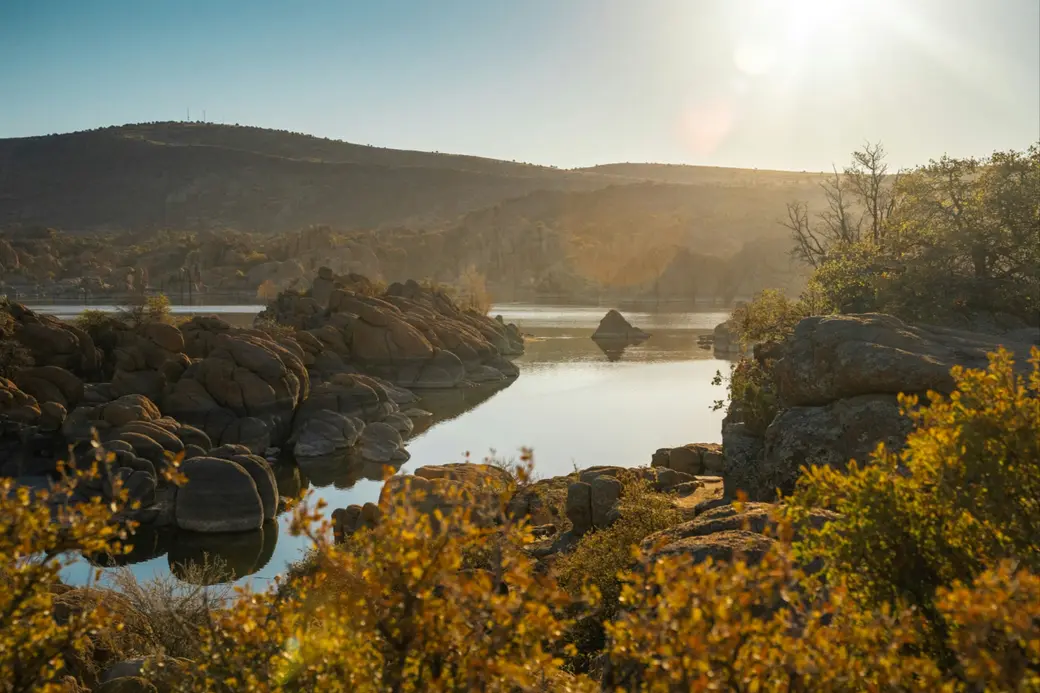
Prescott is built around granite and water. Watson, Willow, Goldwater, Lynx and Granite Basin Lakes are all close to town, and the boulders of the Granite Dells around Watson Lake are something special. The city lists more than 100 miles of trails, including the 56-mile Prescott Circle Trail that loops around town, and the Prescott National Forest is right there.
Flagstaff is built around the mountains. The San Francisco Peaks rise above town to Humphreys Peak, at 12,633 feet the highest point in Arizona. Arizona Snowbowl's ski season typically runs from mid-November into May. The Flagstaff Urban Trails System has about 59 miles of paved and dirt trails through town, the Coconino National Forest surrounds the city, and the Grand Canyon is about 80 miles away.
Short-term rentals
Arizona law doesn't let cities ban short-term rentals or cap their number, but both cities require registration or licensing.
- Prescott requires city registration and an Arizona TPT license for rentals of 29 days or less. Its posted fees are $95 to start ($30 registration plus a one-time $65 safety inspection), then $30 a year. A local contact must respond in person within 45 minutes of a complaint.
- Flagstaff requires a city STR license, renewed yearly, plus a TPT license. Most condo and townhome HOAs in Flagstaff don't allow STRs. See our Flagstaff STR rules guide.
Who each town tends to fit
Prescott tends to fit buyers who want a shorter drive to Phoenix, mild winters with little snow, Costco and Trader Joe's in town, a lake-and-courthouse-square lifestyle, VA care close by, more new construction to choose from and a lower median price.
Flagstaff tends to fit buyers who want a real break from Valley summers, a true four-season mountain town with skiing about half an hour away, Level I trauma care, Amtrak and growing air service, the energy of a university town and access to the Grand Canyon and the Peaks.
How we'd help you decide
If you're torn, this is the order we'd suggest:
- Visit both twice. Spend a weekend in each in January and another in July. Most people know after that.
- Write down your non-negotiables. Snow tolerance, drive time to the people you visit most, healthcare needs, single-level living, lot size and budget usually decide it.
- Compare real homes, not medians. We'd pull homes that match your list in Flagstaff so you can compare them side by side with what you're seeing in Prescott.
- Price the full cost of owning. Taxes, insurance, HOA dues and heating, not just the mortgage. With Brannon's accounting background, this is the part we love digging into.
- Get an insurance quote early. In either town, before you're too far down the road on a specific house.
If Prescott ends up being the right fit, we're happy to connect you with a great agent there.
Frequently asked questions
How far is Prescott from Flagstaff?
About 87 miles, per Discover Flagstaff.
Which is closer to Phoenix, Prescott or Flagstaff?
Prescott. The Arizona Commerce Authority lists it at roughly 90 to 102 miles from Phoenix, vs about 142 miles for Flagstaff. Groome's airport shuttle takes about 2 hours 15 minutes from Prescott and about 3 hours 10 minutes from Flagstaff.
Does Prescott get snow?
Some. Prescott's in-town station averages about 10 inches a year, vs about 90 inches in Flagstaff (1991 to 2020 normals, National Weather Service).
Is Prescott cheaper than Flagstaff?
Generally, yes. In September 2026, the median sale price was $589,950 in Prescott and $755,484 in Flagstaff, and prices drop further in Prescott Valley and Chino Valley. Monthly medians swing, though: in August 2026 the two were almost even.
Are property taxes lower in Prescott or Flagstaff?
Usually lower in Prescott. Ownwell estimates the median yearly bill at about $1,637 in Prescott vs about $2,255 in Flagstaff. The actual bill depends on the home, so we'd pull the tax history for any property you're considering.
Is Flagstaff or Prescott cooler in summer?
Flagstaff. Its average July high is about 82°F, vs about 90°F in Prescott.
Does Prescott have water restrictions on new development?
Prescott is in a state Active Management Area, and since 1999 new subdivisions seeking an Assured Water Supply have had to use renewable water rather than groundwater.
Is it hard to get homeowners insurance in Flagstaff or Prescott?
Most homes can still be insured, but both towns are in wildfire country, and insurers are inspecting more closely. We'd get a quote during your inspection period and look at defensible space around the home.
Weighing your mountain-town options?
We'd love to show you what your budget buys in Flagstaff and help you compare it fairly with the other towns on your list. Book a strategy call with Brannon and Matt.
More in this series
Sources
- Flagstaff MLS (Flexmls) market statistics, City of Flagstaff, residential (September 2026), and resale homes with a Flagstaff address sold October 2025 through September 2026. Analysis by Harlequin Homes Group.
- Signals AZ, September PAAR home sales statistics (October 2026) and August statistics
- Redfin, Prescott housing market (three months ending August 2026)
- Arizona Office of Economic Opportunity, July 1, 2024 population estimates; U.S. Census Bureau county estimates via FRED (Yavapai) and FRED (Coconino)
- NWS Flagstaff climate statistics, NWS Flagstaff monsoon information, and Arizona State Climate Office summaries for Flagstaff and Prescott
- Arizona Commerce Authority, Prescott and Flagstaff community profiles
- Discover Flagstaff, distances
- Coconino County, FY2027 adopted property tax rates; Ownwell property tax estimates for Flagstaff and Prescott; Arizona State Board of Equalization, property tax FAQ and A.R.S. 15-972
- UniSource Energy Services service area; City of Flagstaff, approved water and sewer rates
- KJZZ, Tunnel Fire investigation; Circle of Blue, Flagstaff post-wildfire flooding (August 2025); Flagstaff Watershed Protection Project; azfamily, APS planned shutoffs (June 2026)
- Urban Land Institute, Prescott Area Wildland Urban Interface Commission; Daily Courier, Prescott adopts Wildland-Urban Interface Code
- University of Arizona Cooperative Extension, wildfire and homeowners insurance non-renewals in Arizona (October 2025); Arizona REALTORS®, seller disclosures
- ADWR, Active Management Areas, Prescott AMA brochure and 1999 safe-yield declaration; City of Prescott water resources and Big Chino project; City of Flagstaff water history presentation (October 2025)
- Arizona Mirror, Flagstaff housing and land (September 2022); City of Flagstaff, Timber Sky staff report (May 2025)
- ADOT, I-17 Improvement Project (December 2025); Groome Transportation Flagstaff and Prescott
- Flagstaff Pulliam Airport; azfamily, Delta to Salt Lake City (October 2026); AirlineGeeks, United to Denver (October 2026); City of Prescott, airline service (August 2025)
- Great American Stations, Flagstaff
- Arizona DHS designated trauma centers; Northern Arizona VA Health Care System
- City of Flagstaff FY2024-25 annual financial report; HUD, Prescott housing market profile (August 2024)
- Fiber Broadband Association, Flagstaff fiber study (March 2026); Metronet, Prescott Valley (May 2025)
- City of Prescott, history of the plaza; Prescott Chamber of Commerce; Sharlot Hall Museum, World's Oldest Rodeo; Flagstaff Dark Skies Coalition; Lowell Observatory
- Costco Arizona warehouses, Sam's Club Flagstaff, Trader Joe's Arizona locations and Whole Foods Flagstaff
- City of Prescott, Prescott Circle Trail, trails and lakes; Coconino National Forest; City of Flagstaff, FUTS; Arizona Snowbowl
- City of Prescott vacation rentals and City of Flagstaff STR property owners
- ADOR TPT rate table (October 2026)
This guide is general information, not tax, legal, insurance or investment advice. Prices, rates and rules change. Confirm the details for your situation with the right professional.
Categories
Recent Posts





Let's talk through your plan